
The best prompt management platform for an enterprise is not necessarily the product with the longest feature list. It is the platform that can establish an authoritative source for prompts, assign ownership, control and trace changes, evaluate performance, enforce appropriate governance, provide visibility into actual usage, and manage prompts through a defined lifecycle.
A basic prompt repository may solve storage. A developer-oriented prompt management tool may solve versioning and deployment. An enterprise prompt management platform has to solve a broader operating problem: how an organization manages AI prompts as shared operational assets across people, teams, applications, workflows, models, and governance requirements.
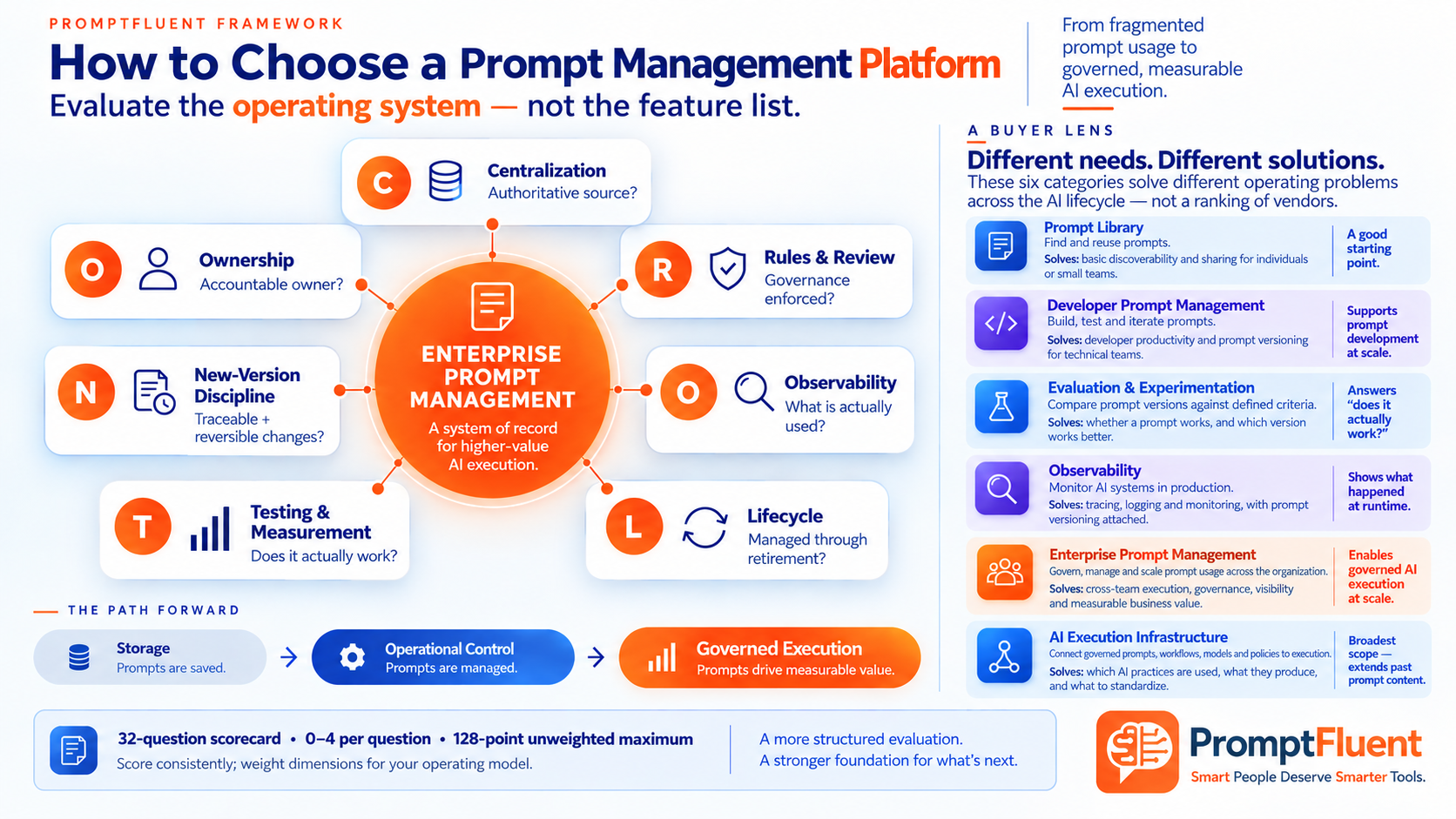
That is why enterprises should evaluate prompt management platforms against seven dimensions:
- C — Centralization
- O — Ownership
- N — New-version discipline
- T — Testing and measurement
- R — Rules and review
- O — Observability
- L — Lifecycle
Together, they form the CONTROL Framework for Enterprise Prompt Management.
This buyer's guide explains how to use that framework, which capabilities matter most, how requirements differ between business and technical teams, what questions to ask vendors, and how to distinguish prompt storage from true operational prompt management. If you want the category primer first, start with what enterprise prompt management software is and how it works.
What Should Enterprises Look for in a Prompt Management Platform?
Enterprises should look for a prompt management platform that can answer seven fundamental questions:
- Where is the authoritative prompt?
- Who owns it?
- What changed, who changed it, and can we reverse the change?
- Do we know whether the prompt works?
- Who is allowed to review, approve, modify, or deploy it?
- Can we see how it is actually being used?
- Can we manage it from creation through retirement?
If a platform cannot answer these questions, it may still be useful. But it is solving a narrower problem.
A shared database may provide excellent centralization. Git may provide excellent version control. An evaluation platform may provide excellent testing. An observability platform may provide excellent runtime visibility.
A dedicated enterprise prompt management platform should be evaluated on how effectively it connects these concerns into a coherent operating system for prompts.
This matters because prompts increasingly function as dependencies in production AI systems.
Amazon Bedrock Prompt Management lets teams create reusable prompts, test variants, save versions, and integrate prompts into applications. AWS also distinguishes between editable drafts and versioned snapshots that can be used in production.
Google Cloud has described fragmented prompt workflows, in which teams design prompts in one place, manage versions in spreadsheets or files, and manually integrate them into code, as a source of inefficiency, versioning problems, and collaboration bottlenecks. Vertex AI's prompt-management capabilities consequently emphasize centralized and programmatic management.
Microsoft now explicitly teaches teams to manage prompts as versioned assets using software-engineering practices as part of GenAIOps.
The category has therefore moved beyond "Where should we save our prompts?"
The enterprise question is: "How should we control, improve, distribute, govern, and understand the AI instructions our organization depends on?"
Why Choosing a Prompt Management Platform Is Harder Than It Looks
Search for prompt management software and you will encounter products solving very different problems under similar terminology.
One platform may be designed primarily for developers building LLM applications. Another may specialize in experimentation and evaluation. Another may be an observability platform with prompt versioning attached. Another may function mainly as a collaborative prompt library. Another may address enterprise-wide prompt management across technical and non-technical teams.
Those products should not be evaluated as though they are interchangeable.
The first step in procurement is therefore not choosing a vendor. It is determining what type of prompt-management problem the organization actually has.
Consider four companies.
Company A
Five developers are building one generative AI application. Their primary requirements are version control, API access, test environments, deployment, and rollback.
A developer-oriented prompt management system may be an excellent fit.
Company B
A marketing organization has 300 employees using AI independently. Its problems are duplicate prompts, inconsistent quality, poor discovery, no ownership, and no standardization.
The problem is organizational prompt management, not merely developer deployment.
Company C
A regulated enterprise has prompts embedded in customer-facing workflows. Its priorities include approvals, permissions, audit history, evaluation, lifecycle status, and accountability.
Governance becomes a major evaluation criterion.
Company D
A global company already has hundreds of AI workflows. Its leadership wants to know which prompts are actually being used, which workflows are producing useful outcomes, where duplicate effort exists, what changed when performance declined, and which AI practices should be standardized.
That requirement extends beyond prompt content management toward AI execution infrastructure and execution intelligence.
The phrase "prompt management platform" can describe elements of all four environments. That is why enterprises need a procurement framework rather than a feature list.
The CONTROL Framework for Enterprise Prompt Management
The CONTROL Framework evaluates whether a platform can support prompt management as an enterprise operating discipline.
| Dimension | The question it answers |
|---|---|
| C — Centralization | Can the organization establish an authoritative system of record? |
| O — Ownership | Can prompts have accountable owners and meaningful business context? |
| N — New-Version Discipline | Are changes versioned, attributable, comparable, and reversible? |
| T — Testing and Measurement | Can teams determine whether prompts actually work? |
| R — Rules and Review | Can permissions, approvals, policies, and governance requirements be operationalized? |
| O — Observability | Can the organization understand prompt usage and execution? |
| L — Lifecycle | Can prompts move deliberately from draft through approval, deployment, and retirement? |
These seven dimensions are deliberately broader than prompt authoring. Writing the prompt is only the beginning. Enterprise management starts when other people, systems, and business processes begin depending on it.
C — Centralization: Can the Organization Establish an Authoritative Source for Prompts?
The first job of a prompt management system is relatively straightforward: bring important prompts under shared management.
That does not mean every experimental prompt created by every employee immediately needs to enter a central system. It means the organization should be able to identify an authoritative location for prompts that have become shared operational assets.
Without centralization, prompts tend to become distributed across AI chat histories, spreadsheets, Google Docs, Word documents, Notion pages, Slack messages, source repositories, wikis, employee bookmarks, and departmental AI tools.
Google Cloud has specifically identified fragmented prompt development and version tracking across different environments, spreadsheets, text files, and code as a workflow problem that centralized prompt management can address.
But centralization is not the same thing as a single source of truth. Putting everything into one database solves location. It does not automatically solve authority.
A true operational source of truth should help users determine:
- which asset is authoritative;
- which version is current;
- who owns it;
- what its status is;
- what it is designed to accomplish;
- where it should be used.
Questions to ask
- Can all relevant teams find prompts from one place?
- Can users search by more than prompt title?
- Can prompts be organized across multiple dimensions?
- Can the platform distinguish canonical prompts from duplicates?
- Can existing prompts be imported without rebuilding them manually?
What good looks like
A strong enterprise platform should move the organization from "I know somebody made a prompt for that" to "Here is the authoritative prompt for this use case, its current state, owner, history, and operating context."
Score the platform highly on Centralization when it provides enterprise-wide discoverability, structured metadata, multidimensional taxonomy, unique asset identity, import and export capabilities, effective search, and duplicate management.
O — Ownership: Can Prompts Have Accountable Owners and Business Context?
Prompts become difficult to govern when nobody is responsible for them.
Consider an enterprise sales-analysis prompt created 18 months ago. It may still appear in search. But does anyone maintain it? Does it reflect the current sales process? Has the product catalog changed? Has the model changed? Does legal still approve the underlying workflow? Is anyone responsible for reviewing it?
Without ownership, organizations accumulate orphaned prompts: assets that remain available even though nobody is accountable for keeping them accurate or useful.
Prompt ownership is therefore more than a metadata field. It should establish responsibility.
LangSmith, for example, supports prompt owners and can restrict certain prompt-management actions to those owners, including the ability to promote commits to environments.
Enterprise requirements may go further. Organizations may need several types of ownership:
- Business owner: accountable for the business purpose and outcome.
- Asset owner: responsible for maintaining the prompt.
- Technical owner: responsible for an application or integration in which the prompt is used.
- Governance approver: responsible for reviewing higher-risk use cases.
Not every prompt requires all four. The important principle is that critical assets should not become operationally ownerless.
Business context matters too
A prompt called analysis-v7-final tells the organization almost nothing.
Useful context may include business function, department, workflow, use case, intended user, intended model, risk classification, applicable policy, data sensitivity, and lifecycle state. That context makes prompts manageable at scale.
Questions to ask
- Can a prompt have a named owner?
- Can responsibility be reassigned?
- Can ownership be associated with teams as well as individuals?
- Can the organization record why the prompt exists and where it belongs?
- Can stale or ownerless assets be identified?
N — New-Version Discipline: Are Prompt Changes Versioned, Attributable, Comparable, and Reversible?
Prompts change AI behavior. That makes prompt changes operational changes.
Enterprise platforms should therefore preserve meaningful history rather than allowing users to silently overwrite an existing prompt.
AWS Prompt Management creates versioned snapshots from working drafts and allows applications to reference particular versions. AWS also provides side-by-side comparison between prompt versions and lets users compare model responses.
LangSmith similarly provides prompt commit history, staging and production environments, promotion, and rollback.
Microsoft's GenAIOps guidance explicitly applies version-control principles to prompts as code assets and teaches workflows for testing and safely deploying prompt changes.
These examples illustrate an important procurement requirement:
Versioning should preserve operational meaning, not merely generate revision numbers.
The platform should help answer:
- What changed?
- Who changed it?
- When?
- Why?
- What version was previously active?
- What evaluation evidence supported the change?
- Can we restore an earlier version?
- Which version is actually being used?
Versioning vs. duplication
These are different.
If an employee copies Prompt A, changes three sentences, and saves it as Prompt B, that may create another asset rather than another version.
At scale, enterprises need to distinguish intentional variation from uncontrolled duplication. Otherwise the organization can have impeccable version history inside each asset while still accumulating hundreds of unnecessary parallel prompts. That accumulation is one of the clearest symptoms of prompt debt.
Questions to ask
- Does every meaningful revision create traceable history?
- Can versions be compared?
- Is attribution recorded?
- Can an earlier version be restored?
- Can production use reference a stable version?
- Can the system distinguish versions from derivative prompts?
T — Testing and Measurement: Can Teams Determine What Actually Works?
A new prompt is not necessarily a better prompt. Neither is a longer prompt. Neither is the version preferred by the most senior person in the meeting.
Prompt management platforms should help organizations move from subjective editing toward evidence-based improvement.
AWS Prompt Management allows users to test prompts, compare variants, provide test variables, and compare model responses before creating production versions.
This is critical because:
Version control tells you what changed. Testing tells you what the change did.
But enterprise evaluation also requires organizations to decide what "better" means. Depending on the workflow, useful criteria may include factual accuracy, completeness, consistency, instruction adherence, formatting, safety, brand alignment, task success, user acceptance, latency, token consumption, human editing required, and business-specific outcome measures.
There is no universal prompt-quality score. A prompt that produces creative campaign ideas should not necessarily be evaluated using the same criteria as a prompt extracting contract clauses.
Offline testing vs. production measurement
Enterprises should distinguish two types of evidence.
- Pre-deployment evaluation: Does the new prompt perform well on defined test cases before release?
- Post-deployment measurement: Does it continue to perform well when real people use it under real operating conditions?
A strong evaluation model connects both. For a practical method, see our guide to prompt optimization and testing.
Questions to ask
- Can prompt variants be tested before release?
- Can evaluations use representative datasets or test cases?
- Can the organization define its own quality criteria?
- Can performance be compared between versions?
- Can evaluation evidence be retained alongside the asset?
- Can production feedback inform future improvement?
R — Rules and Review: Can Governance Requirements Be Enforced?
Prompt management and prompt governance are related but distinct. Prompt management handles the asset lifecycle. Prompt governance determines the rules under which that lifecycle operates.
Those rules may include who can see prompts, who can edit them, who can approve them, who can deploy them, which use cases require review, which teams may use them, which data may be used with them, and when they must be reassessed.
NIST's Generative AI Profile is designed to help organizations incorporate trustworthiness considerations into the design, development, use, and evaluation of generative AI systems. The broader NIST AI RMF emphasizes governance, roles, responsibilities, documentation, measurement, and ongoing risk management across the AI lifecycle.
That does not mean every prompt requires an elaborate approval workflow. Governance should be proportionate.
A personal brainstorming prompt and a prompt influencing a consequential customer or employee workflow do not necessarily warrant identical controls. The platform should therefore support risk-based governance, not simply maximum governance.
Permissions matter
There is a meaningful difference between permission to view, execute, copy, edit, approve, deploy, deprecate, and delete.
A platform that offers only "admin" and "user" may be sufficient for a small team and inadequate for a complex enterprise.
Review should affect operational state
One of the most important buying questions is: what actually happens when a prompt is not approved?
If "approval" is merely a status label that users can ignore, the organization has documentation. It may not have operational control.
A more mature model connects lifecycle state with what users and systems are allowed to do. That is the principle behind AI execution governance: the approval decision reaches the point of execution instead of stopping at a spreadsheet column.
Questions to ask
- Are roles and permissions granular enough for your operating model?
- Can approval requirements differ by use case or risk level?
- Can only authorized people promote a prompt into an approved or production state?
- Are governance decisions traceable?
- Can lifecycle state influence actual availability or execution?
O — Observability: Can the Organization Understand Usage and Execution?
This is where many prompt repositories reach their limit.
They can tell you what exists. They may not be able to tell you what is happening. Those are different capabilities.
An enterprise may have 5,000 prompts in a centralized library but still have no idea:
- which 200 matter;
- which are never used;
- which versions employees actually execute;
- where teams are creating duplicates;
- what models are being used;
- which prompts require repeated human correction;
- where performance deteriorated.
Observability closes part of that gap.
For developer-oriented environments, observability may mean traces, latency, token usage, errors, model calls, prompt versions, and application executions.
For business environments, it may also mean adoption, reuse, department, role, workflow, user feedback, and outcome quality.
Not every prompt management product includes runtime observability. Some organizations deliberately combine separate prompt-management, evaluation, and observability systems. That can be a valid architecture.
The procurement requirement is therefore not "Does one vendor do everything?"
It is: "Can we construct a reliable chain between the prompt we manage and the execution we need to understand?"
Questions to ask
- Can usage be attributed to specific prompt versions?
- Can the organization identify unused or underused assets?
- Can prompt execution be connected to users, workflows, or applications where appropriate?
- Can teams see performance over time?
- Can telemetry be exported or integrated with other enterprise systems?
L — Lifecycle: Can Prompts Move From Creation to Retirement Deliberately?
Every operational asset eventually changes state. Prompts should be no different.
A useful lifecycle might be Draft → Review → Approved → Deployed → Deprecated. Another company may use Experimental → Validated → Production → Archived.
The exact names do not matter. What matters is that lifecycle state conveys operational meaning.
AWS distinguishes between working drafts and saved prompt versions intended for production use. LangSmith provides staging and production environments and allows teams to promote or roll back prompt commits.
An enterprise platform may require additional business-oriented lifecycle controls. For example:
- Draft: the prompt is still being developed.
- Review: the prompt is ready for evaluation or governance review.
- Approved: the prompt has satisfied defined requirements.
- Deployed: the prompt is actively available in an operational workflow.
- Deprecated: the prompt should no longer be selected for new work.
- Retired: the prompt remains in historical records but is no longer operational.
Deprecation is particularly important
Many knowledge systems have a creation process. Few have a retirement process.
Without deprecation, old prompts remain discoverable alongside current prompts indefinitely. That creates ambiguity.
Enterprise prompt management should therefore answer not only "How do we add prompts?" but "How do we systematically remove obsolete prompts from active use without destroying their history?"
The 32-Question Enterprise Prompt Management Scorecard
Use the following 32 questions during vendor selection, RFP development, product demonstrations, or proof-of-concept evaluation.
Score every question:
- 0 — Not supported
- 1 — Manual or workaround required
- 2 — Partially supported
- 3 — Fully supported
- 4 — Fully supported and enforceable or automated
Maximum unweighted score: 128 points.
The score itself should not determine the purchase. The purpose is to force consistent comparison.
The 32 questions below are also available as a free interactive tool. The Enterprise Prompt Management Scorecard walks through the same instrument one CONTROL dimension at a time, applies your own weighting, and produces a printable evaluation report that flags every question a vendor answered with a workaround or a no. Nothing you enter leaves your browser.
Centralization (5 questions, maximum 20)
- Q1. Can the platform become an authoritative source for shared enterprise prompts? Look for more than storage. Determine whether assets have stable identities and authoritative status.
- Q2. Can prompts be organized using multiple dimensions? Evaluate function, department, role, workflow, use case, risk, model, status, and other metadata.
- Q3. Can users reliably search and discover existing prompts? Test actual search behavior using realistic terminology.
- Q4. Can existing prompts be imported and exported efficiently? Avoid architectures that require rebuilding the organization's knowledge manually.
- Q5. Can the platform identify or reduce duplicate prompt creation? Ask whether duplicate management is structural, manual, or absent.
Ownership (4 questions, maximum 16)
- Q6. Can each important prompt have an accountable owner?
- Q7. Can ownership be associated with teams or functions as well as individuals?
- Q8. Can ownership be reassigned when employees change roles or leave?
- Q9. Can the system surface orphaned or unmaintained prompt assets?
New-Version Discipline (5 questions, maximum 20)
- Q10. Does the platform maintain full prompt version history?
- Q11. Can users compare versions and see exactly what changed?
- Q12. Is every material change attributable to a user or process?
- Q13. Can authorized users restore or roll back earlier versions?
- Q14. Can applications or users reference stable approved versions rather than an uncontrolled latest draft?
Testing and Measurement (5 questions, maximum 20)
- Q15. Can teams test prompt variants before release?
- Q16. Can prompts be evaluated against representative test cases or datasets?
- Q17. Can the enterprise define workflow-specific evaluation criteria?
- Q18. Can performance be compared across prompt versions, models, or configurations?
- Q19. Can evaluation evidence and production feedback inform future revisions?
Rules and Review (5 questions, maximum 20)
- Q20. Does the platform support role-appropriate access control?
- Q21. Can edit, approve, deploy, and administrative permissions be separated?
- Q22. Can different prompts or use cases have different review requirements?
- Q23. Are approval and governance decisions recorded in an audit history?
- Q24. Can governance state affect whether a prompt may actually be used or deployed?
Observability (4 questions, maximum 16)
- Q25. Can the organization determine which prompts and versions are actually being used?
- Q26. Can usage be understood by relevant application, workflow, team, or organizational context?
- Q27. Can the organization see outcome, quality, feedback, or other execution signals where required?
- Q28. Can telemetry be exported or integrated with the enterprise's wider AI and data stack?
Lifecycle (4 questions, maximum 16)
- Q29. Can prompts move through defined lifecycle states?
- Q30. Can lifecycle transitions have permissions or required reviews?
- Q31. Can obsolete prompts be deprecated without erasing historical records?
- Q32. Can the organization identify assets that require review, maintenance, or retirement?
How to Weight the Scorecard
Not every organization should weight CONTROL equally.
A regulated enterprise may prioritize Rules and Review. A software company building production LLM applications may prioritize New-Version Discipline and Testing. A large professional-services organization may prioritize Centralization, Ownership, and Observability.
A useful starting weighting is:
| CONTROL dimension | General enterprise weighting |
|---|---|
| Centralization | 15% |
| Ownership | 10% |
| New-Version Discipline | 15% |
| Testing and Measurement | 20% |
| Rules and Review | 15% |
| Observability | 15% |
| Lifecycle | 10% |
| Total | 100% |
Do not treat these percentages as an industry standard. They are a starting framework. Adjust them before evaluating vendors.
Otherwise procurement teams tend to unconsciously overweight whichever product has the most impressive demo.
The scorecard tool makes you set those percentages before any scoring starts, which puts the weighting decision on the record while it is still a judgment about the business rather than an argument about a vendor.
Prompt Library vs. Developer Tool vs. Enterprise Prompt Management Platform
One of the easiest procurement mistakes is comparing products from different categories as though they solve the same problem.
| Requirement | Prompt library | Developer prompt management | Enterprise prompt management |
|---|---|---|---|
| Central prompt storage | Yes | Yes | Yes |
| Search and discovery | Strong | Varies | Strong |
| Business taxonomy | Often | Limited or varies | Expected |
| Version control | Limited or varies | Strong | Expected |
| API access | Limited or varies | Strong | Often |
| Deployment environments | Rare | Strong | Depends on operating model |
| Evaluation | Limited | Often | Increasingly important |
| Business ownership | Basic or varies | Limited | Expected |
| Permissions | Basic | Technical | Enterprise-oriented |
| Approval workflows | Limited | Varies | Often important |
| Cross-functional access | Strong | Often technical | Expected |
| Runtime observability | Rare | Often or adjacent | Advanced capability |
| Adoption visibility | Limited | Application-focused | Organizationally relevant |
| Lifecycle governance | Limited | Deployment-focused | Enterprise-focused |
This table illustrates why asking for the "best prompt management platform" without specifying the operating model is not useful.
The correct question is: best for what? We go deeper on the library side of this comparison in Prompt System vs Prompt Library.
Technical Architecture Questions to Ask Vendors
Feature requirements are only half of enterprise procurement. Architecture can determine whether the platform scales with the organization.
1. Where are prompts stored?
Understand hosting, tenancy, environment separation, backup, retention, and regional considerations where relevant.
2. How are prompts identified?
A durable asset should have a stable identity independent of its display name.
3. How are versions represented?
Ask whether versions are immutable snapshots, editable records, commits, aliases, or environment pointers.
4. Can prompts be managed programmatically?
For technical teams, evaluate APIs, SDKs, webhooks, CI/CD integration, and programmatic retrieval.
LangSmith, for example, exposes SDK-based prompt management and can retrieve specific prompt commits or tags programmatically.
5. Can prompt versions be separated from application releases?
This can be valuable when prompt changes need to move faster than application deployments. But separation increases the importance of testing, approvals, and version traceability.
6. What does a prompt asset actually contain?
Prompt management increasingly includes more than the visible instruction text. Depending on the system, assets may include system instructions, variables, model selection, inference settings, examples, tools, and metadata.
Amazon Bedrock prompt variants, for example, can include prompt messages along with model or inference configuration.
7. Is the platform tied to a specific model provider?
Model-provider-specific systems may integrate deeply with that ecosystem. Model-independent systems may provide broader organizational portability.
Neither is automatically better. The choice depends on the enterprise architecture.
8. What happens when the enterprise wants to leave?
Ask about prompt export, metadata export, version-history export, evaluation-data portability, API access, and vendor-specific dependencies.
A system of record should not become a system of captivity.
Security and Governance Considerations
Prompt-management procurement should involve security and governance stakeholders when the use case warrants it. The relevant questions will differ by organization, data type, industry, geography, and architecture.
At minimum, buyers should understand authentication options, the access-control model, administrative roles, audit history, data handling, data retention, encryption, integration permissions, model-provider relationships, export controls, logging, incident-management practices, and deployment architecture.
Do not assume that the presence of the word "enterprise" answers these questions. Ask for evidence. (PromptFluent's answers live on our Trust and Security page, which is exactly where you should expect any vendor to keep theirs.)
And distinguish between three separate things:
- The platform's security: how the vendor protects its own system and customer data.
- The platform's governance capabilities: what controls the product gives your organization.
- Your organization's AI governance policy: the rules your enterprise decides to implement using those capabilities.
A product cannot substitute for the third. If you are still drafting that policy, our AI governance framework is a reasonable starting point.
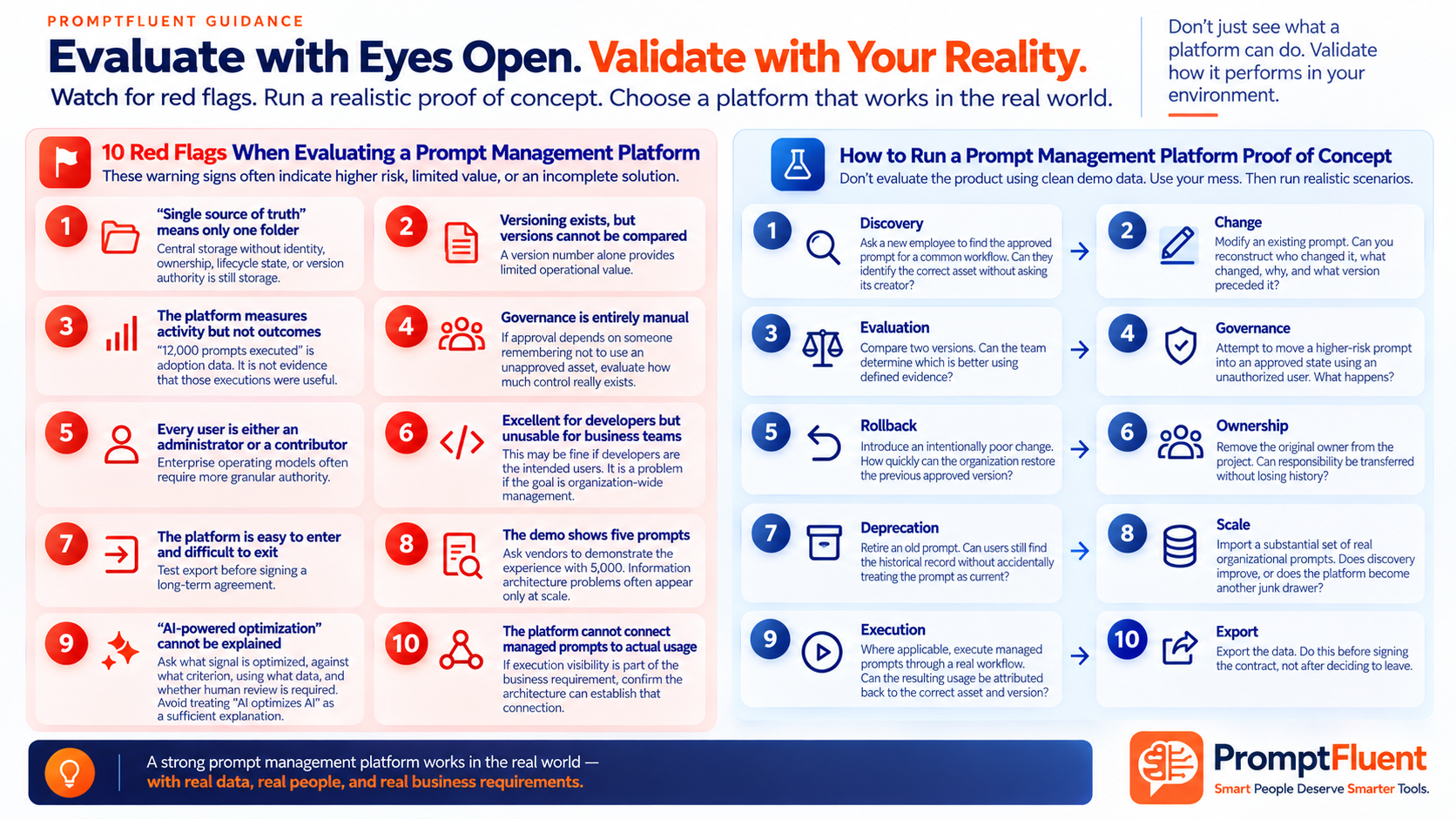
10 Red Flags When Evaluating a Prompt Management Platform
1. "Single source of truth" means only one folder
Central storage without identity, ownership, lifecycle state, or version authority is still storage.
2. Versioning exists, but versions cannot be compared
A version number alone provides limited operational value.
3. The platform measures activity but not outcomes
"12,000 prompts executed" is adoption data. It is not evidence that those executions were useful.
4. Governance is entirely manual
If approval depends on someone remembering not to use an unapproved asset, evaluate how much control really exists.
5. Every user is either an administrator or a contributor
Enterprise operating models often require more granular authority.
6. The system is excellent for developers but unusable for business teams
This may be fine if developers are the intended users. It is a problem if the procurement goal is organization-wide management.
7. The platform is easy to enter and difficult to exit
Test export before signing a long-term agreement.
8. The demo shows five prompts
Ask vendors to demonstrate the experience with 5,000. Information architecture problems often appear only at scale.
9. "AI-powered optimization" cannot be explained
Ask: What signal is being optimized? Against what criterion? Using what data? Is a human review required? Can recommendations be audited?
Avoid treating "AI optimizes AI" as a sufficient product explanation.
10. The platform cannot connect managed prompts to actual usage
If execution visibility is part of the business requirement, confirm the architecture can establish that connection.
Feature comparisons reveal what a vendor says the platform can do. A realistic proof of concept reveals how those capabilities behave under organizational complexity. Use the red flags as investigation triggers, then test the platform with real prompts, users, governance conditions, workflows, versions, and export requirements.
How to Run a Prompt Management Platform Proof of Concept
Do not evaluate the product using clean demo data. Use your mess.
A useful proof of concept should contain duplicate prompts, stale prompts, multiple versions, prompts owned by different departments, business-user prompts, developer prompts, high-risk and low-risk use cases, different AI models, and conflicting naming conventions.
Then run realistic scenarios.
Scenario 1: Discovery
Ask a new employee to find the approved prompt for a common workflow. Measure whether they can identify the correct asset without asking its creator.
Scenario 2: Change
Modify an existing prompt. Can the organization reconstruct who changed it, what changed, why, and what version preceded it?
Scenario 3: Evaluation
Compare two versions. Can the team determine which is better using defined evidence?
Scenario 4: Governance
Attempt to move a higher-risk prompt into an approved state using an unauthorized user. What happens?
Scenario 5: Rollback
Introduce an intentionally poor change. How quickly can the organization restore the previous approved version?
Scenario 6: Ownership
Remove the original owner from the project. Can responsibility be transferred without losing history?
Scenario 7: Deprecation
Retire an old prompt. Can users still find the historical record without accidentally treating the prompt as current?
Scenario 8: Scale
Import a substantial set of real organizational prompts. Does discovery improve, or does the platform become another junk drawer?
Scenario 9: Execution
Where applicable, execute managed prompts through a real workflow. Can the resulting usage be attributed back to the correct asset and version?
Scenario 10: Export
Export the data. Do this before signing the contract, not after deciding to leave.
Which Type of Prompt Management Software Should You Choose?
The right answer depends on the problem.
Choose a prompt library when:
- the primary problem is discovery;
- prompt volume is modest;
- governance requirements are light;
- prompts are mostly reusable knowledge assets;
- deployment is not a major concern.
Choose developer prompt management when:
- prompts primarily live in AI applications;
- engineers are the main users;
- Git, API, and SDK workflows matter;
- staging and production environments matter;
- application deployment is the core use case.
Choose an evaluation-first platform when:
- systematic testing is the dominant requirement;
- the organization already has effective asset management;
- model and prompt comparison are central.
Choose an observability-oriented system when:
- production runtime visibility is the dominant requirement;
- tracing and debugging matter more than broad business-user management.
Choose an enterprise prompt management platform when:
- prompts are used across departments;
- technical and non-technical users need shared infrastructure;
- ownership matters;
- governance matters;
- lifecycle management matters;
- the organization needs an authoritative prompt system of record.
Look toward broader AI execution infrastructure when:
- prompts are only one component of the problem;
- the organization also needs workflow management;
- governance needs to affect execution;
- AI usage needs to be measured;
- leadership needs visibility into operational outcomes;
- prompts, workflows, models, policies, and execution intelligence need to be connected.
This last distinction matters. The goal of enterprise AI is not to build the world's most meticulously organized prompt collection. It is to execute useful work with AI reliably.
The Procurement Question That Matters Most
Most prompt-management buying conversations begin with features. They should begin with operating questions.
Ask:
If 5,000 employees and dozens of AI-enabled workflows depend on this system three years from now, will we know what is approved, what is being used, who owns it, what changed, how it performs, and what should happen next?
If the answer is yes, you are evaluating an operational management system.
If the answer is "Well, everything will be in one place," you may be evaluating a repository.
There is nothing wrong with a repository when a repository solves the problem. The mistake is buying storage when the enterprise actually needs control.
The Bottom Line
Choosing a prompt management platform is not primarily a software-shopping exercise. It is an operating-model decision.
The enterprise needs to decide whether prompts will remain saved text or become managed organizational assets.
If prompts are becoming part of recurring business work, the platform should make it possible to answer: Where is the authoritative prompt? Who owns it? What changed? Does it work? Who approved it? Where is it being used? What state is it in?
Those are the seven questions behind CONTROL: Centralization. Ownership. New-version discipline. Testing and measurement. Rules and review. Observability. Lifecycle.
A platform that answers all seven is doing considerably more than organizing prompts. It is providing infrastructure for repeatable, governed AI execution.
Evaluate PromptFluent Against the CONTROL Framework
PromptFluent approaches prompt management as part of an integrated AI execution lifecycle rather than as static prompt storage.
Use the CONTROL scorecard above to evaluate PromptFluent, and every other platform you are considering, against the operating requirements that matter to your organization. We would rather lose a deal on a fair scorecard than win one on a demo with five prompts in it.
You can also see how PromptFluent compares to other platforms, or talk to us about running the proof-of-concept scenarios above against your own prompts.
Continue the series: Enterprise Prompt Management Software: What It Is and How It Works is the category primer, and Best Prompt Management Platforms for Enterprises compares the leading platforms for 2026.
Glossary
- Prompt management platform: Software that stores, organizes, versions, tests, governs, distributes, and measures the prompts an organization uses with generative AI.
- CONTROL Framework: PromptFluent's seven-dimension model for evaluating prompt management platforms: Centralization, Ownership, New-Version Discipline, Testing and Measurement, Rules and Review, Observability, and Lifecycle.
- System of record: The authoritative source for an asset's identity, current version, owner, status, and context. More than a shared folder.
- Orphaned prompt: A prompt that remains discoverable and usable but has no accountable owner maintaining it.
- Prompt versioning: Preserving each meaningful change to a prompt as an attributable, comparable, and reversible version.
- Versioning vs. duplication: A version is a controlled revision of one asset. A duplicate is a derivative copy saved as a new asset. Enterprises need to tell them apart.
- Pre-deployment evaluation: Testing a prompt against defined cases before it is released for use.
- Post-deployment measurement: Observing how a prompt performs under real usage after release.
- Risk-based governance: Applying heavier controls to consequential prompts and lighter controls to low-risk experimentation, rather than uniform maximum governance.
- Lifecycle state: A prompt's operational status, such as Draft, Review, Approved, Deployed, Deprecated, or Retired.
- Deprecation: Removing a prompt from active use for new work while preserving its history.
- Observability: The ability to see which prompts and versions are executed, by whom, in which workflows, and with what results.
- GenAIOps: Microsoft's term for applying software-engineering and operations practices to generative AI assets, including prompts.
- Prompt debt: The accumulated cost of fragmented, duplicated, stale, ungoverned, or unmeasured prompts across an organization.
- AI execution infrastructure: The layer that connects governed prompts, workflows, models, and policies to actual execution and outcomes.
Sources
- Amazon Web Services, Construct and Store Reusable Prompts with Prompt Management in Amazon Bedrock. Creation and reuse of prompts, variables, variants, testing, versioning, model and inference configuration, and application integration.
- Amazon Web Services, Deploy a Prompt to Your Application Using Versions in Prompt Management. Draft-versus-version distinction, immutable point-in-time versions, deployment, and switching between configurations.
- Amazon Web Services, Compare Versions of a Prompt in Prompt Management. Side-by-side version comparison, change visibility, and comparison of model responses.
- Amazon Web Services, Test a Prompt Using Prompt Management. Testing prompts and configurations, providing test values, iterating, and creating versions after testing.
- Google Cloud, Announcing Prompt Management in the Vertex AI SDK. Problems caused by fragmented prompt workflows; centralized, programmatic prompt management in Vertex AI.
- Microsoft Learn, Manage Prompts for Agents in Microsoft Foundry with GitHub. Prompts as versioned assets, version-control principles, testing, and safe promotion in GenAIOps.
- LangChain, Manage Prompts — LangSmith. Prompt versions, commit history, staging and production environments, rollback, owners, access controls, and webhooks.
- LangChain, Manage Prompts Programmatically — LangSmith. SDK-based prompt management and programmatic retrieval of specific commits or versions.
- National Institute of Standards and Technology, AI Risk Management Framework: Generative Artificial Intelligence Profile (NIST AI 600-1). Lifecycle-oriented management of generative AI risk and integration of trustworthiness considerations across design, development, use, and evaluation.
Pro Tip
Ready to put these insights into action? Check out our curated prompt library with templates specifically designed for your industry and use case.
Browse Prompts